
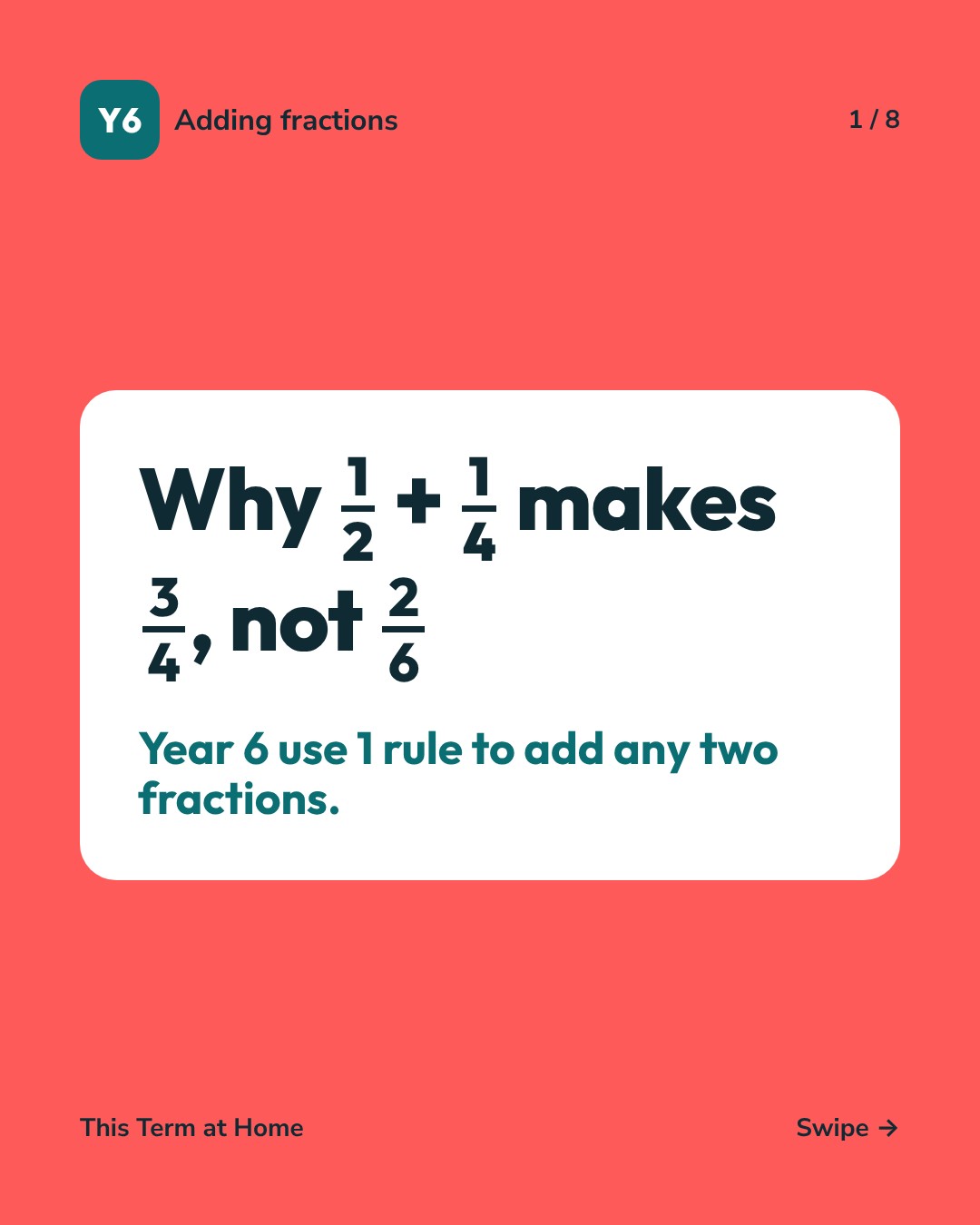
Why 1/2 + 1/4 makes 3/4, not 2/6
Adding fractions: how do you add fractions with different denominators? Make the denominators (bottom numbers) match, then add the numerators (top numbers). Most Year 6 classes are working on fractions around now.



The method in words
The 2 steps for 1/2 + 1/4:
- Make the denominators match. Multiply the top and bottom of 1/2 by 2: 1/2 = 2/4
- Add the numerators and keep the denominator: 2/4 + 1/4 = 3/4
The common slip is adding the denominators too. 1/2 + 1/4 isn't 2/6: the denominator says how many equal parts make 1 whole, so it stays 4, and 2 quarters plus 1 quarter is 3 quarters.
For harder pairs, find a number both denominators go into. For 1/3 + 1/4 that's 12. Multiply 1/3 by 4, top and bottom, to get 4/12, and 1/4 by 3 to get 3/12. Then 4/12 + 3/12 = 7/12.
Try it with a ruler: draw 2 bars 16 cm long. Mark one every 8 cm and shade 1 part, the other every 4 cm and shade 1. Mark the first bar every 4 cm too, and count the shaded quarters: 3.
Sources: Oak National Academy, Year 6 lesson "Add and subtract non-related fractions with different denominators"; national curriculum for maths, Year 6. Contains public sector information licensed under the Open Government Licence v3.0.
Get the free sheet for your child's year
Pick your child's year: one page on what most classes are learning until Christmas, and 3 things to try at home.
One short email each Sunday about the week ahead. Unsubscribe any time.